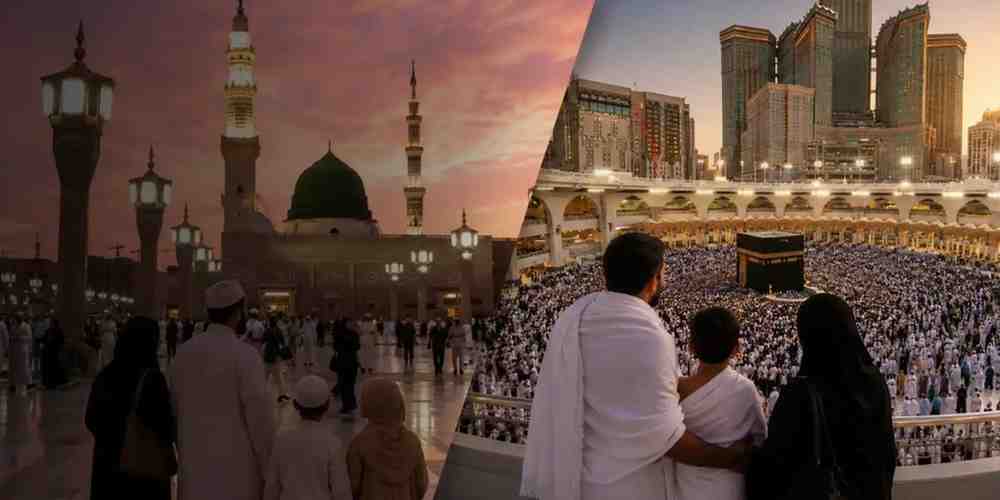
Masjid Quba (Arabic: مسجد قباء, also spelled Masjid-e-Quba) in Madinah, Saudi Arabia, was established during the Hijrah in 622 CE, about 3.5 kilometers from Masjid an-Nabawi. It is the first mosque established by the Prophet Muhammad (peace be upon him) after migration; purification before departure followed by prayer there carries an Umrah-equivalent reward.
For American pilgrims, this guide concerns that historic Quba Mosque—not a North American mosque sharing its name.
My recommendation: make wudu at your Madinah hotel, visit in the cooler morning after the sunrise prayer-restriction window, and ride rather than walk if heat or mobility makes the journey difficult. Saturday follows the Prophet’s practice, but another day is better than missing the visit altogether.
Why Masjid Quba in Madinah matters—and what survives today
The story begins before the Prophet entered central Madinah.
During the Hijrah from Makkah in 622 CE, corresponding to 1 AH, he stayed in Quba among Banu Amr ibn Awf. Historical accounts identify the mosque’s site with land belonging to his host, Kulthum ibn al-Hidm, and describe the Prophet participating in construction alongside his Companions.
Quba is commonly called the first masjid in Islam. More precisely, it is the first mosque established by the Prophet after the Hijrah—not a claim that worship at the Kaaba began later.
The white Quba Mosque that visitors photograph is not the original seventh-century structure. Successive rulers rebuilt and enlarged it. Saudipedia dates the inauguration of the King Fahd expansion to 1987 and describes four 47-meter minarets, 62 domes, heat-reflective marble, a 5,035-square-meter prayer hall, and a 13,500-square-meter site accommodating about 20,000 worshippers.
A larger project, announced on April 8, 2022, targets approximately 50,000 square meters and capacity for 66,000 worshippers. It also includes development of 57 surrounding heritage sites. Those are project targets, not proof that every component is finished. Saudi Press Agency confirmed newly developed shaded courtyards serving pilgrims in May 2026.
That distinction matters when an older photograph shows an entrance exactly where you expect to walk.
Is Masjid Quba mentioned in the Quran?
Surah At-Tawbah 9:108 says, in Mustafa Khattab’s translation:
“Do not ˹O Prophet˺ ever pray in it. Certainly, a mosque founded on righteousness from the first day is more worthy of your prayers. In it are men who love to be purified. And Allah loves those who purify themselves.”
The verse does not explicitly name Quba. Ibn Kathir connects it with Quba in the context of Masjid ad-Dirar; an authentic report in Sahih Muslim 1398a identifies the Prophet’s Mosque as founded on piety. A careful explanation acknowledges both rather than claiming exclusive identification.
This association explains the descriptive name Masjid at-Taqwa, the mosque of righteousness.
What exactly earns the reward of an Umrah?
The hadith evidence comes from Sahl ibn Hunayf, who reported that the Prophet said:
“Whoever purifies himself in his house, then comes to the Quba’ Mosque and offers one prayer therein, will have a reward like that for ‘Umrah.”
That is Sunan Ibn Majah 1412, graded hasan in the Darussalam grading displayed by Sunnah.com. It should not be mislabeled as a narration from Sahih al-Bukhari.
A supporting narration, Jami at-Tirmidhi 324, states: “The Salat in Masjid Quba is like Umrah.” It is also graded hasan there.
Do you have to make wudu at your hotel?
To follow the detailed narration as closely as possible, make wudu at your accommodation before setting out. Do not deliberately postpone it until Quba simply because facilities exist there.
Notice another detail: Ibn Majah’s quoted wording says “one prayer,” not explicitly “two rak’ahs.” The Prophet’s practice of praying two rak’ahs at Quba is separately recorded in Sahih al-Bukhari 1194. Together, these explain the familiar recommendation to arrive purified and pray two rak’ahs.
After the two rak’ahs, make general du’a in your own words; no special Quba-specific wording is required.
If your wudu breaks en route, renew it before praying. Do not turn uncertainty about the particular reward into a reason to abandon a valid prayer; ask a qualified scholar about your circumstances rather than accepting a driver’s ruling.
The promise concerns reward. It does not turn the visit into an actual Umrah or replace its rites.
Must the visit be on Saturday?
No. Sahih al-Bukhari 1193 records that the Prophet visited every Saturday, sometimes walking and sometimes riding. Saturday follows that practice; the reward narration does not restrict the visit to Saturday.
And riding is in the narration too. There is no reason to exhaust an elderly parent to prove devotion.
How do you get from Masjid an-Nabawi to Masjid Quba?
Quba Mosque stands southwest of Masjid an-Nabawi on Hijra Road, approximately 3.5 kilometers—2.2 miles—away. The developed Quba pedestrian corridor itself is about 3 kilometers, or 1.9 miles. Your hotel location and starting gate explain some differences between published distances.
All dollar equivalents below are calculated at $1 USD = SAR 3.75, rounded to the nearest cent. Reported fares are not guaranteed quotes.
Walking: choose the weather, not just the distance
Follow the paved Quba Walkway, also called Quba Avenue, toward Quba Mosque. Hajj Umrah Planner puts the walk at roughly 45–60 minutes each way, with shops and cafés along the route.
Cost: $0 / SAR 0.
Use comfortable shoes, carry water, and check the return conditions before committing to both directions. A pleasant outward walk does not guarantee a pleasant return in stronger sun.
For a mixed-age family, walking there and riding back is a sensible compromise.
Golf cart or buggy: confirm the pickup and per-person fare
Published buggy guidance identifies pickups near Gate 310, Gate 333, and Masjid al-Ghamamah in front of Elaf Al Taqwa Hotel. It reports these one-way, per-person fares:
| Reported pickup | Reported fare |
|---|---|
| Gate 310 / al-Ghamamah | $2.67 / SAR 10 |
| Gate 333 | $5.33 / SAR 20 |
The reported journey takes 10–15 minutes, depending on pedestrian traffic. Cash and card payments are reported, with return buggies available near the Quba drop-off area. These are informal service details, not an official fixed tariff.
Before boarding, ask: “How much per person, one way?” Confirm the return arrangement separately and carry small-denomination cash even if card payment is advertised.
Those are reported Masjid an-Nabawi-area pickup references, not women’s entrance numbers at Quba.
Uber, Careem, or street taxi: better for hotel-door pickup
For families with tired children or limited walking tolerance, a car is my first choice — and if you travel with Al Buraq Travels, it can be arranged from your hotel as part of your US Umrah Packages.
Check Uber or Careem on the day for the current fare and pickup point. With a street taxi, agree the total vehicle fare, destination, and any waiting charge before getting in.
Do not compare a buggy’s per-person price with a taxi’s whole-car price as though they were equivalent.
Madinah Bus: confirm the route before relying on it
Madinah’s urban bus network serves Quba, but published route and fare information is not consistent enough to promise a current direct service from your Nabawi-area stop. Check the Madinah Bus app for the nearest stop, transfers, current fare, and return service before setting out.
Seasonal shuttles are different. Official Ramadan announcements have specified particular parking origins and operating windows — if you’re travelling in Ramadan, see Ramadan Umrah Packages from USA for what’s included.
For a short stay with elderly relatives, I would choose a buggy with a confirmed pickup or a car booked from the hotel.
When should you visit—and can women pray inside?
Is Masjid Quba open 24 hours?
Quba is reported open for prayer throughout the day and night. An all-hours opening directive appeared in a ministry circular reported by Arab News on June 20, 2021, during the COVID period; that historical announcement alone does not establish today’s access arrangements. Hajj Umrah Planner also describes day-and-night access.
Do not assume every entrance or prayer section stays accessible continuously. Confirm late-night access locally, particularly for the women’s section, and follow staff directions during cleaning or crowd control.
For the visit itself, allow 30–45 minutes as a planning allowance, longer if your group needs assistance.
What is the best time to visit?
Choose a cooler morning after the sunrise restriction has ended, rather than automatically heading over for immediate voluntary prayer after Fajr. Check the local timetable or ask your group scholar.
After dark avoids direct sun, but do not confuse cooler weather with guaranteed quiet. Avoid building a tight return around a prayer-time crowd surge. Friday (Jumu’ah) is Quba Mosque’s busiest day — people pray at Quba before heading to Jumu’ah at the Prophet’s Mosque; for Eid prayer, follow the same rule of checking the current local announcement rather than relying on a time printed here.
For Masjid Quba salah (prayer) times, check the date-specific Madinah timetable and the mosque’s iqamah notices. A permanent Fajr or Asr time printed in a travel article would soon become wrong.
Can women pray in Masjid Quba?
Yes. The mosque has separate women’s prayer sections. Saudipedia confirms separate men’s and women’s provision, while traveler accounts show that the experience varies—some describe adequate facilities; others report restricted space or views.
Ask staff for the currently open women’s entrance. I would not send a family toward a fixed gate number based on conflicting online descriptions.
Agree on an outdoor meeting point before separating. Women’s access should be planned with the same care as the buggy ride.
Can you pray two nafl rak’ahs after Fajr or Asr?
There is a genuine scholarly disagreement about tahiyyat al-masjid, the mosque-greeting prayer, during restricted times.
One position permits it because it has a specific cause: entering the mosque. Islam Q&A presents that view, including after Fajr and Asr.
The Hanafi position presented by Shaykh Faraz Rabbani does not permit this greeting prayer in those disliked times and recommends remembrance instead.
Quba’s special virtue does not erase that disagreement. Follow your established school or trusted scholar. The simplest itinerary avoids the issue: visit after the morning restriction ends, before the sun reaches its zenith, or after Maghrib.
Which nearby stops belong in the same outing?
Bir Ghars is approximately 1,500 meters—0.9 mile—northeast of Quba, according to Saudipedia. That is a separate outing from the mosque plaza, not a well immediately outside its door. Add it by car if extra walking would strain the group.
Bir Aris, the Ring Well, has an authentic historical connection: Sahih al-Bukhari 5879 records that Uthman dropped the Prophet’s ring into it and it was not recovered. That establishes the story, not current visitor access to an exposed well. Do not promise families a visible, functioning well beside the mosque.
For a lighter addition, browse the Quba Front market area or arrange a visit to an accessible date farm or orchard. The development includes markets and heritage landscapes, but a restoration plan does not mean every farm welcomes walk-in visitors. Confirm the particular property first.
Pray first. Shopping and optional heritage stops should not become a hurried obstacle course.
Quba, Qiblatain, and the miqat are different places
Masjid Quba is not Masjid al-Qiblatain. Quba is associated with the Hijrah foundation and the particular prayer reward. Qiblatain is the separate Mosque of the Two Qiblahs. Do not assume it is the next stop along Quba Walkway.
Quba is not a miqat. For travelers departing Madinah toward Makkah for Umrah, the designated miqat is Dhul Hulayfah, commonly called Abyar Ali — and Al Buraq Travels builds that Madinah-to-Makkah leg into its US Umrah Packages. Sahih al-Bukhari 1524 establishes Dhul Hulayfah as Madinah’s miqat and includes travelers passing through with pilgrimage intentions.
No ihram is required simply to visit Quba.
Frequently asked questions about visiting Masjid Quba
Do I need to make wudu at my hotel before visiting Masjid Quba?
To follow the detailed reward narration, make wudu at your hotel or accommodation before leaving for Quba, then pray there. Sunan Ibn Majah 1412 specifies purification at home before the visit. If your wudu breaks on the way, renew it before praying; ask a qualified scholar about the particular reward in that circumstance.
Do I have to visit Masjid Quba on Saturday?
No. Visiting on Saturday follows the Prophet’s practice, recorded in Sahih al-Bukhari 1193, but the Umrah-reward narration does not restrict the visit to Saturday. Choose another day if Saturday does not fit your itinerary.
Can women pray in Masjid Quba?
Yes. Masjid Quba has separate women’s prayer sections. Ask staff for the currently open women’s entrance rather than relying on an unverified gate number, and confirm section access locally if planning a late-night visit.
Is Masjid Quba a miqat for Umrah?
No. For pilgrims traveling from Madinah toward Makkah for Umrah, the designated miqat is Dhul Hulayfah, commonly called Abyar Ali—not Masjid Quba. No ihram is required simply to visit Quba.
Are Masjid Quba and Masjid Qiblatain the same mosque?
No. They are separate mosques in Madinah. Quba is associated with the Hijrah foundation and the Umrah-equivalent prayer reward; Qiblatain is the Mosque of the Two Qiblahs. Do not assume Qiblatain is another stop along Quba Walkway.
Is Masjid Quba open 24 hours?
Quba is reported open for prayer day and night. Arab News reported an all-hours ministry directive on June 20, 2021, and Hajj Umrah Planner also describes day-and-night access. Confirm current overnight arrangements locally; those reports do not guarantee every entrance or the women’s section remains continuously accessible.
How much is the golf cart from Masjid an-Nabawi to Masjid Quba?
Published guidance reports one-way buggy fares of $2.67 / SAR 10 per person near Gate 310 or al-Ghamamah, and $5.33 / SAR 20 per person near Gate 333. These are reported fares, not an official fixed tariff. Confirm the pickup and per-person price before boarding. Dollar equivalents use $1 USD = SAR 3.75.
Before leaving the United States, settle your entry arrangements through Umrah Visa for US Citizens and Umrah Visa vs Tourist Visa USA. Ramadan travelers should also review Ramadan Umrah Packages from USA.
Then ask Al Buraq Travels to build Quba into your US Umrah Packages itinerary—with hotel wudu, a realistic pickup, women’s access, and a return plan agreed before you leave the lobby.